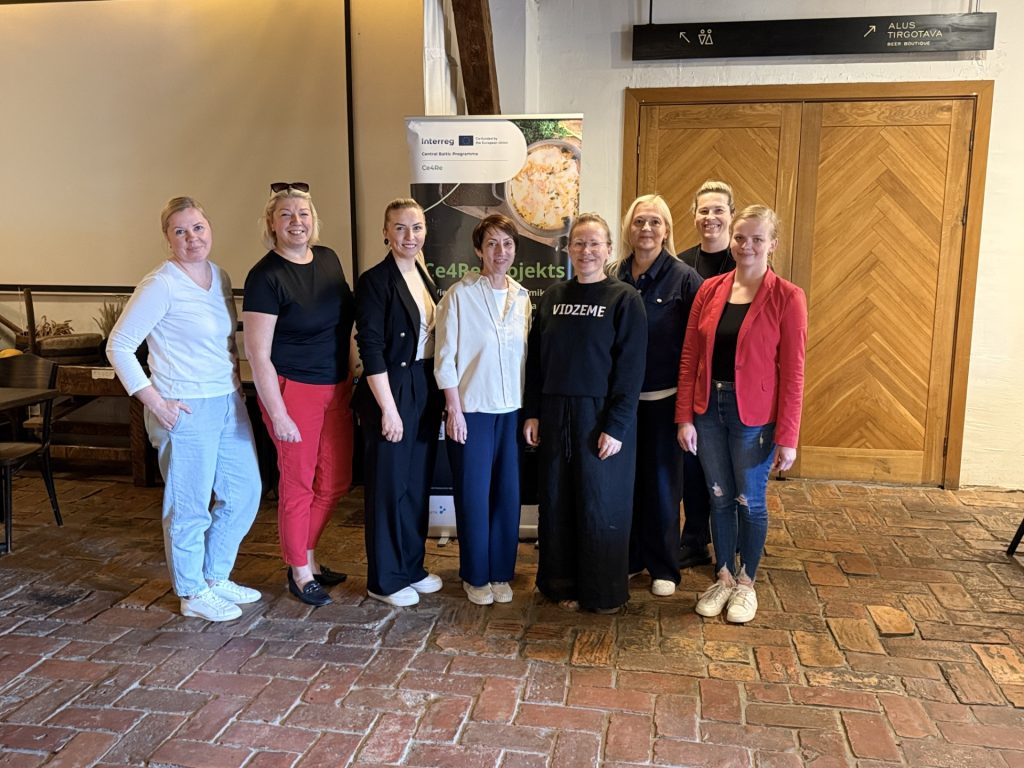
The Interreg Central Baltic Programme 2021–2027 project “Development of joint circular solutions in the CB restaurant sector” (Ce4Re) has come to an end. Over the past three years, the Vidzeme Planning Region, together with partners from Finland and Sweden, worked to introduce more sustainable and efficient practices in the food service sector. The project delivered a wide range of educational activities, digital tools for restaurants and their customers, a recipe competition and masterclass, international knowledge exchange opportunities, and practical cooperation with restaurants to reduce food waste.
The project addressed a growing need to reduce food waste and improve resource efficiency. According to data published by Latvia’s Ministry of Climate and Energy and research conducted within the LIFE project Waste To Resources Latvia, approximately 269,000 tonnes of food waste are generated annually in Latvia, equivalent to around 144 kilograms per person. The food service sector alone accounts for approximately 16,700 tonnes of food waste each year. European Union targets require a 30% reduction in food waste within the food service sector by 2030.
The main objective of Ce4Re was to support food service businesses in integrating circular economy principles into their daily operations by improving resource management, reducing food waste, optimizing processes, and strengthening business competitiveness and sustainability. Throughout the project, sustainability was highlighted not as an added value but as an increasingly essential prerequisite for long-term business success.
At the beginning of the project, restaurants from Vidzeme and other regions of Latvia were invited to participate and become part of the transition towards a more sustainable food service industry. In total, 15 restaurants from Latvia, Finland, and Sweden took part in developing and testing the project’s digital solutions: the Food Waste Reduction Tool, the Menu Design Tool, and the EkoGo application. Testing these tools in real-life restaurant environments provided valuable feedback for further improvements and adaptation to different business needs.
To strengthen the knowledge and capacity of industry professionals, the project organized an extensive webinar series entitled “Implementing Circular Economy Principles in the Restaurant Sector.” Industry experts and practitioners shared practical insights on sustainable business management.
Topics covered included an introduction to the circular economy, circular menu planning, food waste prevention and reduction, sustainability communication and marketing, and the development of efficient and sustainable food service businesses. Recordings of the webinars, translated into Latvian, have been made publicly available, ensuring that restaurants and other interested stakeholders can continue to benefit from the project’s resources after its completion.
One of the most popular sessions was the webinar “An Efficient and Sustainable Modern Food Service Business,” which explored how restaurants can reduce costs, use resources more efficiently, and improve customer experience. Throughout the project, it became increasingly clear that sustainability in the restaurant sector is not only about environmental responsibility but also about smarter business management.
A key project outcome was the development of a Food Waste Monitoring Tool that enables restaurants to track food waste generation, analyze operational processes, and make data-driven decisions to improve resource efficiency.
Practical cooperation with restaurants and pilot testing of the tool became one of the project’s most significant activities. Participating businesses reported that the tool not only helped them measure food waste more accurately but also encouraged meaningful changes in daily habits and mindsets among both staff and customers.
The experience of the Latvian pilot restaurants demonstrates that regular food waste monitoring helps businesses better understand the causes of waste and implement practical improvements. By using the project’s monitoring tool, restaurants Valmiermuiža’s Beer Kitchen, Mieriņš, Wolmar, Bazārs, and Mr. Biskvīts achieved food waste reductions ranging from 18% to 38%. The greatest impact came from improved portion planning, more accurate purchasing forecasts, and increased staff engagement and awareness regarding food waste reduction.
The project results confirm that the principle “You can’t manage what you don’t measure” applies equally to the food service industry. Systematic data collection helps identify major sources of waste, reduce food waste volumes, and lower operational costs.
Baiba Siktāre, manager of Mieriņš Ltd., notes that participation in the project enabled a much deeper understanding of the causes and impacts of food waste. She also observed significant changes in customer behavior, with more guests choosing to take unfinished food home instead of discarding it.
Similarly, Liāna Dance, manager of Hotel Wolmar Ltd., emphasizes that the tool encouraged a more thorough evaluation of everyday processes and resource use. Converting food waste into measurable data and costs helped the team better analyze operations and improve attitudes toward resource management.
Marita Mastiņa, manager of Valmiermuižas Alus Ltd., highlights the importance of staff engagement. She explains that employees’ attitudes changed significantly once food waste was directly linked to financial losses, increasing awareness and motivation to use products more efficiently.
In addition to the Food Waste Monitoring Tool, the project developed a Circular Menu Tool that helps restaurants design more sustainable menus, optimize ingredient use, and adopt environmentally responsible cooking practices. The tool also includes recipes from the competition “Latvia’s Sustainable Menu Recipes of 2025.”
Another important outcome is the EkoGo mobile application, designed to help consumers discover, rate, and recommend sustainable dining establishments while giving businesses greater visibility for their environmentally responsible practices.
As the project concludes, the Vidzeme Planning Region encourages food service businesses to continue using the project’s freely available digital tools:
The tools, methodological materials, and knowledge developed throughout the project will remain available beyond the project’s lifetime, enabling restaurants and other food service businesses to continue implementing sustainable and efficient solutions in their daily operations.
About the Project
The project “Ce4Re” (Development of joint circular solutions in the CB restaurant sector) is implemented within the Interreg Central Baltic Programme 2021–2027. Its goal is to promote sustainable resource use in the food service sector by helping restaurants optimize resource planning and reduce environmental impact. The project involves partners from Latvia, Finland, and Sweden.
Co-funded by the European Union (EU). The views and opinions expressed are those of the author and do not necessarily reflect those of the EU. Neither the EU nor the granting authority can be held responsible for them.