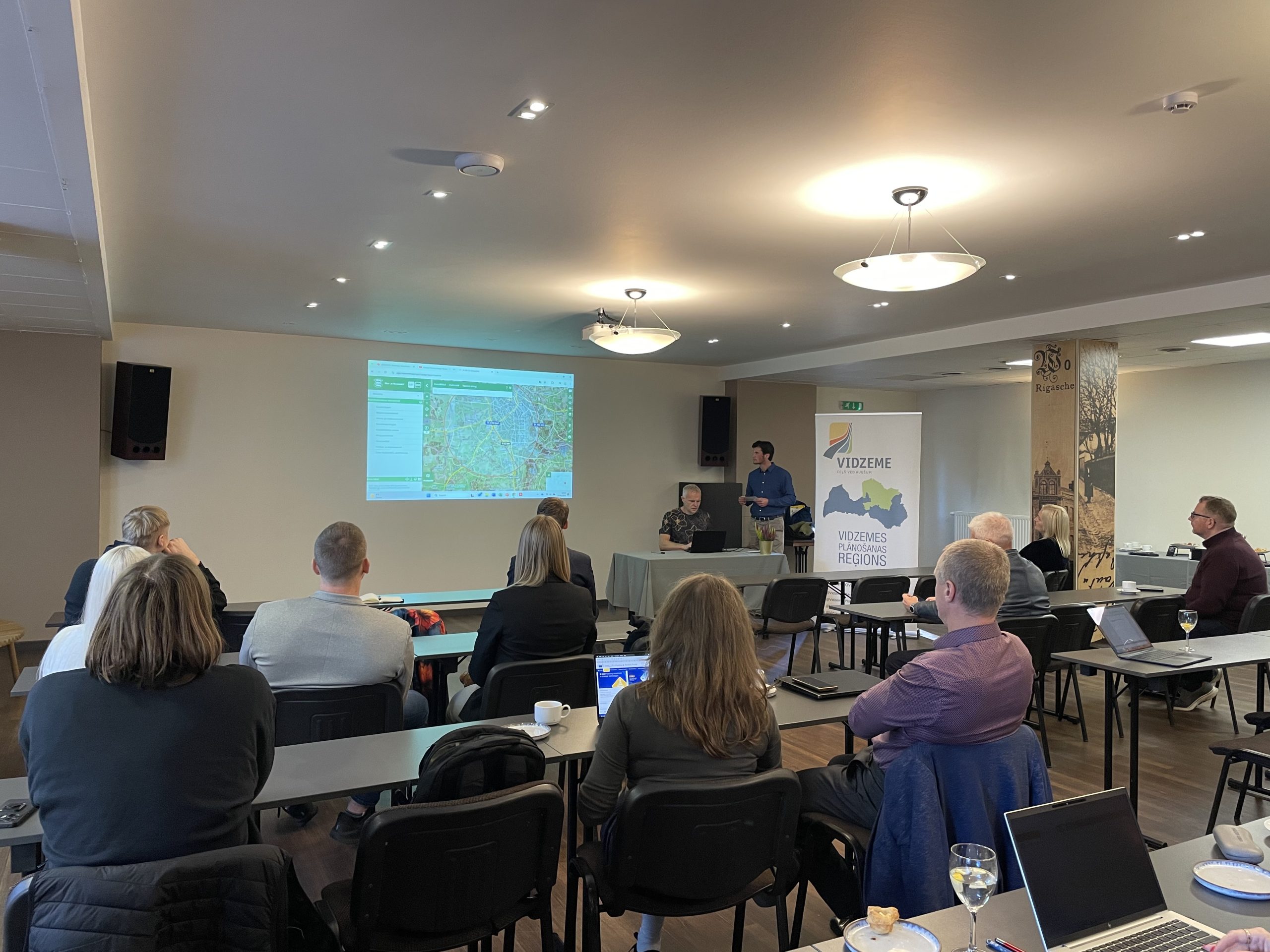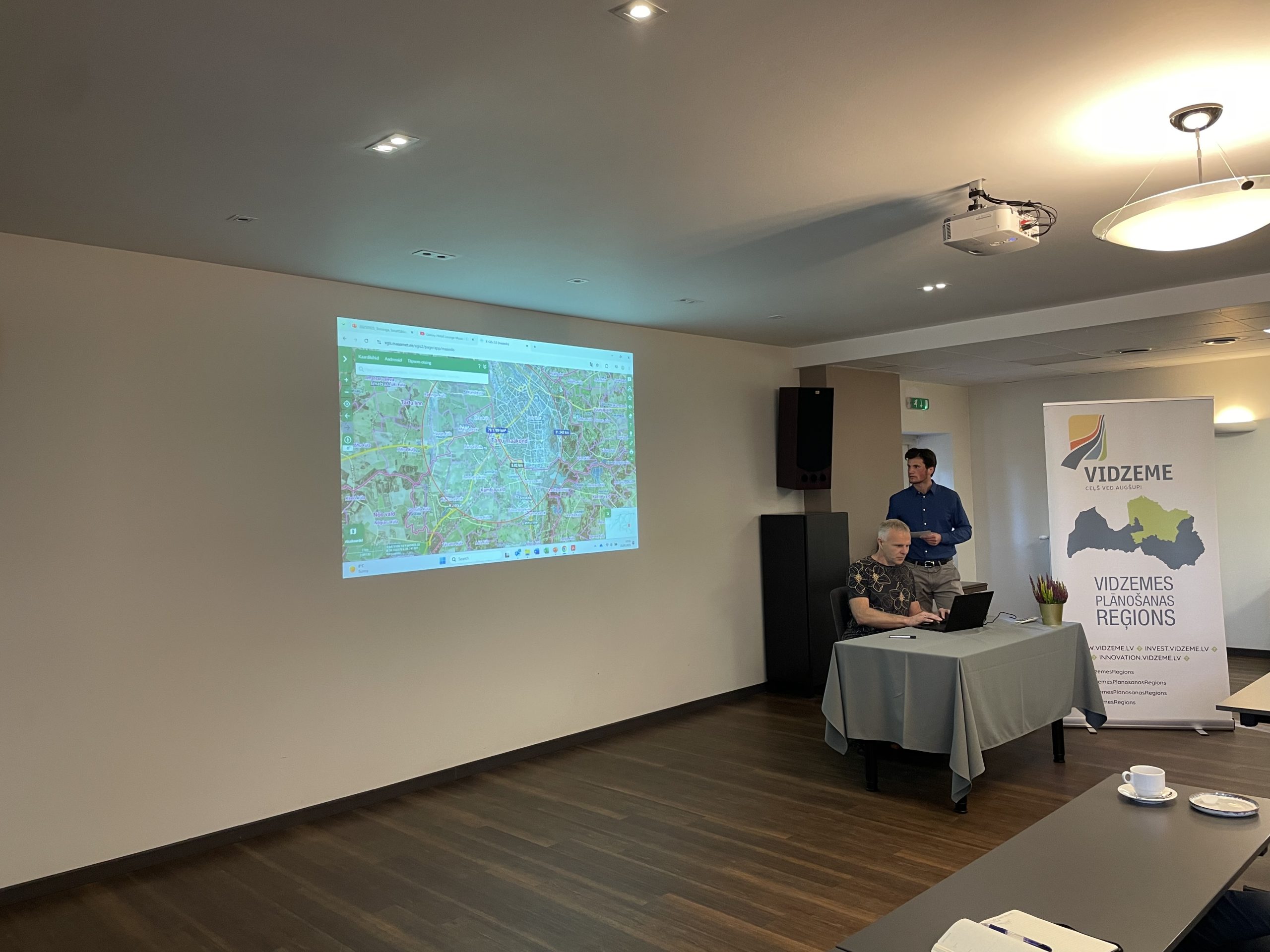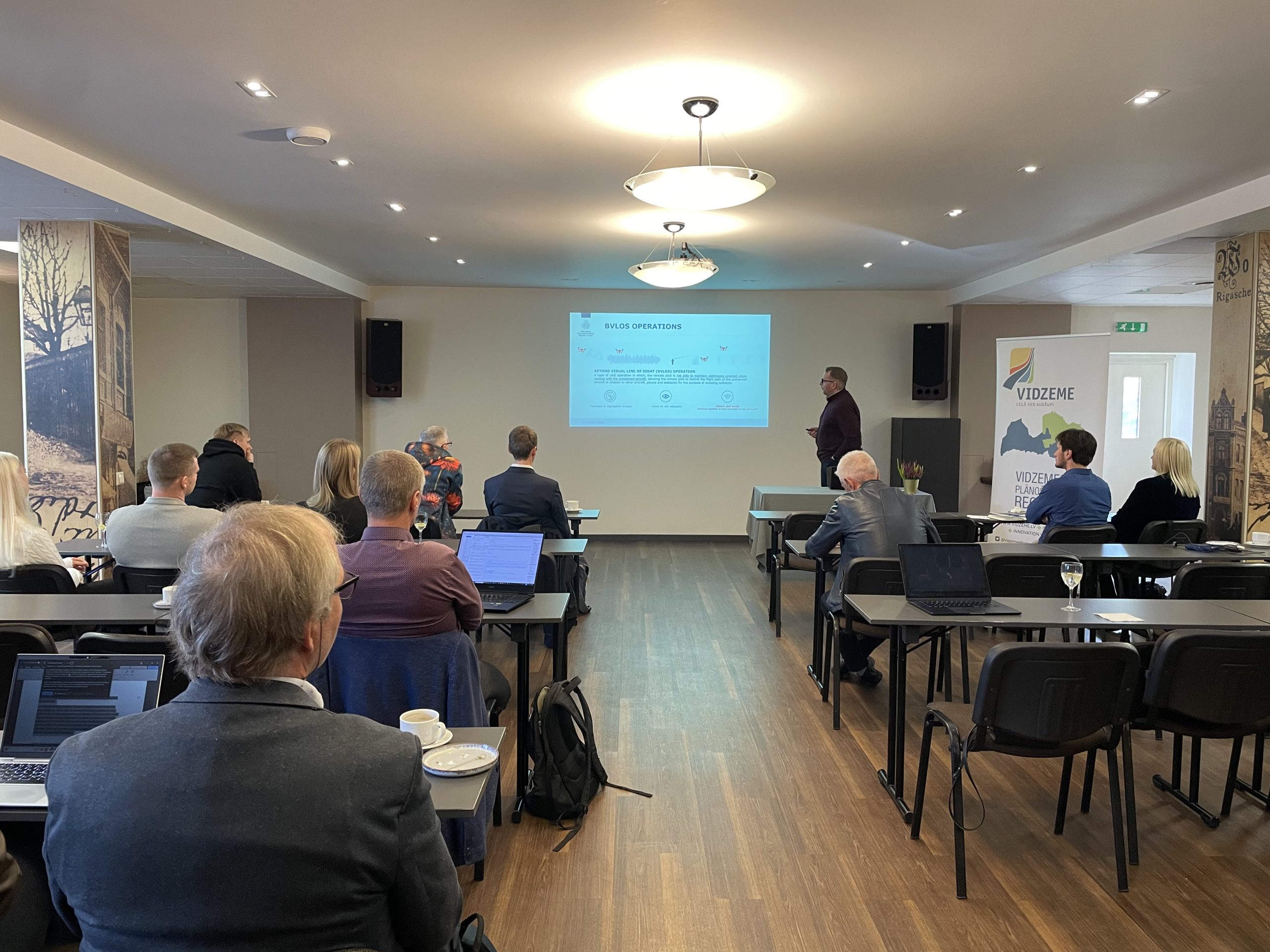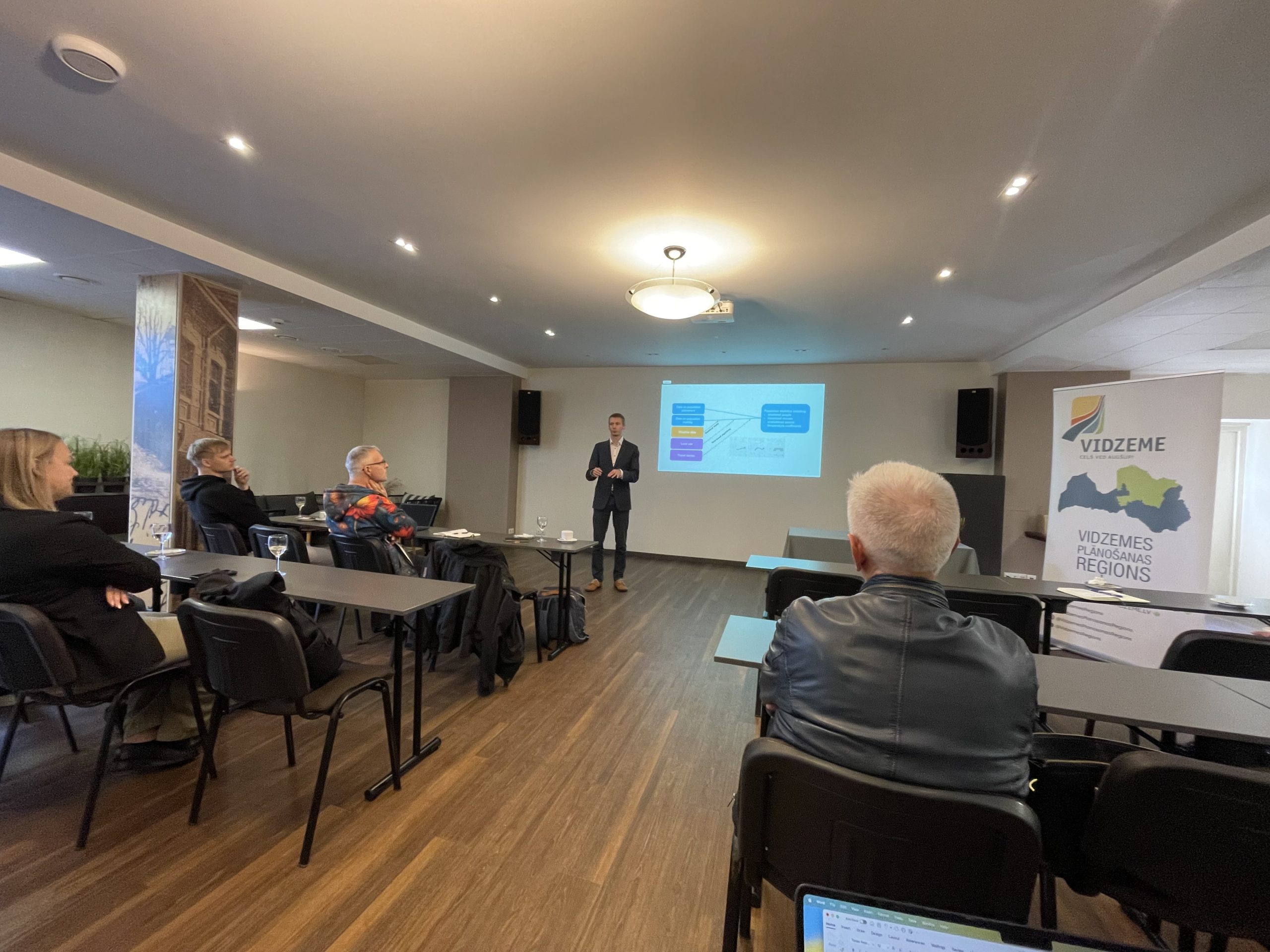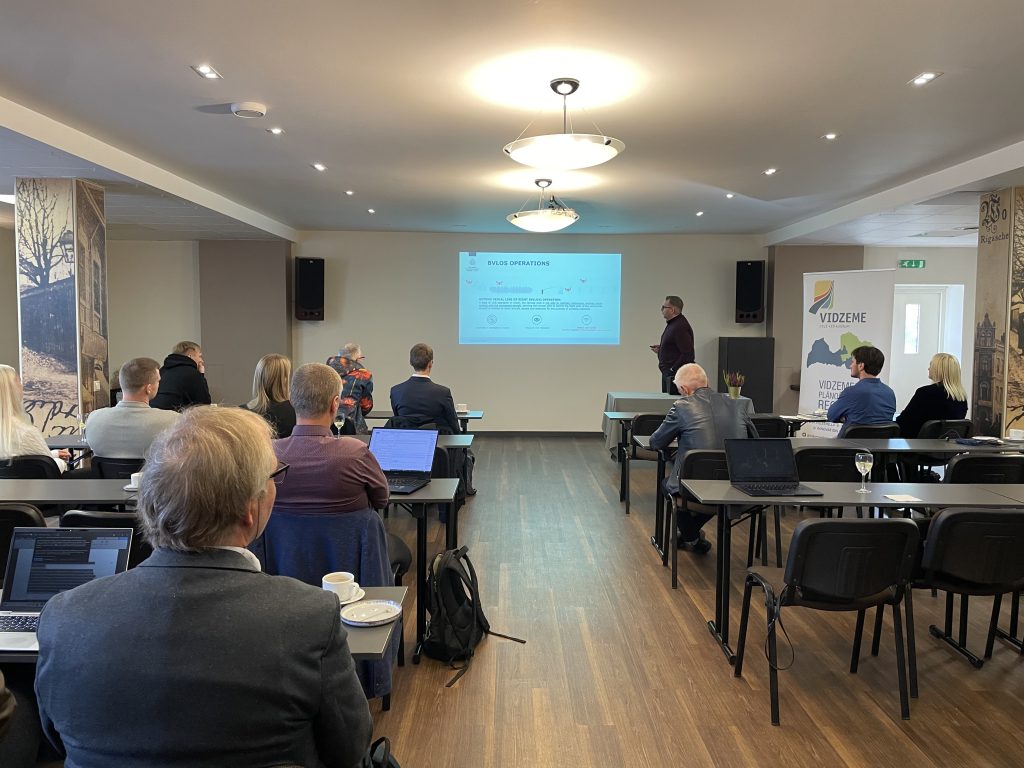
On Thursday, September 25, the fourth seminar of the “Smart Skies” project “Smart Skies Drone Seminar: Making Flights Possible” was held in Valmiera, organized by the Vidzeme Planning Region.
The event brought together various stakeholders from Latvia and Estonia – drone technology researchers and developers, regulatory and public administration specialists, as well as training organization representatives to discuss industry development opportunities, the challenges of BVLOS (Beyond Visual Line of Sight) flights, and the promotion of cross-sector cooperation.
The seminar was briefly opened by Krišjānis Pundurs from the Vidzeme Planning Region, who presented the progress made so far in the “Smart Skies” project – a strategy for drone service development in Valmiera Municipality and Tartu for the next five years has been developed, and a contract has been signed with SIA “Ģeodēzists” to conduct drone flights in Valmiera Municipality. These flights will be used to collect data needed for territorial planning and monitoring, including the creation of 3D models of objects and mapping materials. Meanwhile, the project’s lead partner, Tartu Science Park, represented by Peeter Unt, introduced a drone pilot project that has not yet been carried out in Estonia or in Tartu – planned drone flights in urban environments aimed at monitoring territories and infrastructure for the needs of municipalities and emergency services.
Drone flight instructor (speckategorija.lv) Rihards Rušenieks presented EU drone regulations, emphasizing that they can sometimes seem overly complex, creating challenges for operators and the industry as a whole. In line with the seminar’s theme, he focused particularly on requirements for flights at different altitude categories and for various specific-category flights in urban and non-urban areas – necessary permits, risk assessments, operator requirements, and reserved airspace rules. He also highlighted the importance of both – theoretical and practical training for specific-category flights.
The discussion on regulations and risk assessments was continued by Ago Tominga from the University of Tartu, who explained how mobile positioning data can be used to assess population density and movement patterns along a drone’s flight path, thereby reducing potential risks in case control of the drone is lost. However, as Ago pointed out, not all mobile operators are ready to participate in this project and provide researchers with real-time data. If a platform could be developed to visualize population density in a given time, place, and flight area, it would be invaluable for regulation development and flight planning in urban areas.
Flight safety in BVLOS operations was explained in detail by Juris Grants, Senior Inspector at the Unmanned Aircraft Safety Department of the Civil Aviation Agency. He stressed that these flights are particularly complex both technically and regulatorily, since the existing SERA (Standardised EU Rules of the Air) rules are not adapted to drones, and there is insufficient data about other airspace users, such as balloons, helicopters, or agricultural drones, which creates collision risks. He provided numerous technical examples and clarifications on how BVLOS flights are planned, as well as the challenges posed by the lack of air traffic data and the need to develop new regulatory solutions.
At the seminar’s conclusion, Ivo Vaicis from Riga Technical University presented RTU’s work in drone technologies, highlighting how research is transferred into practical applications and how university contributes to industry development. He also pointed out research challenges – the rapid pace of technological development, competitiveness, restrictions on disclosing certain technological achievements publicly, the need for appropriate student education, as well as regulatory barriers and limited opportunities for test flights. He emphasized the importance of the Academic Drone Technology Group, which serves as a unified platform bringing together various competencies and partners, focusing not on specific drone types but on advancing the technology as a whole. He also mentioned several projects where RTU is involved as a partner, demonstrating the university’s contribution to fostering innovation in the drone sector.
As seminar participants concluded, the development of drone technology requires close cooperation among researchers, regulators, industry representatives, and educational institutions. The discussions and presentations revealed both technical and regulatory challenges – such as BVLOS flights and specific-category requirements – as well as new approaches to safety and risk assessment using mobile data and innovative platforms.
Such seminars are organized quarterly within the framework of the “Smart Skies” project with the aim of creating a common contact network – a unified “drone ecosystem” – to bring together the interested parties.
The project “Joint development of drone-based municipal services” (Smart Skies (EE-LV00141)) is implemented with the financial support of the EU Interreg Estonia-Latvia program for 2021–2027.
This message reflects the author’s opinion. The program’s managing authority is not responsible for the possible use of the information contained therein.