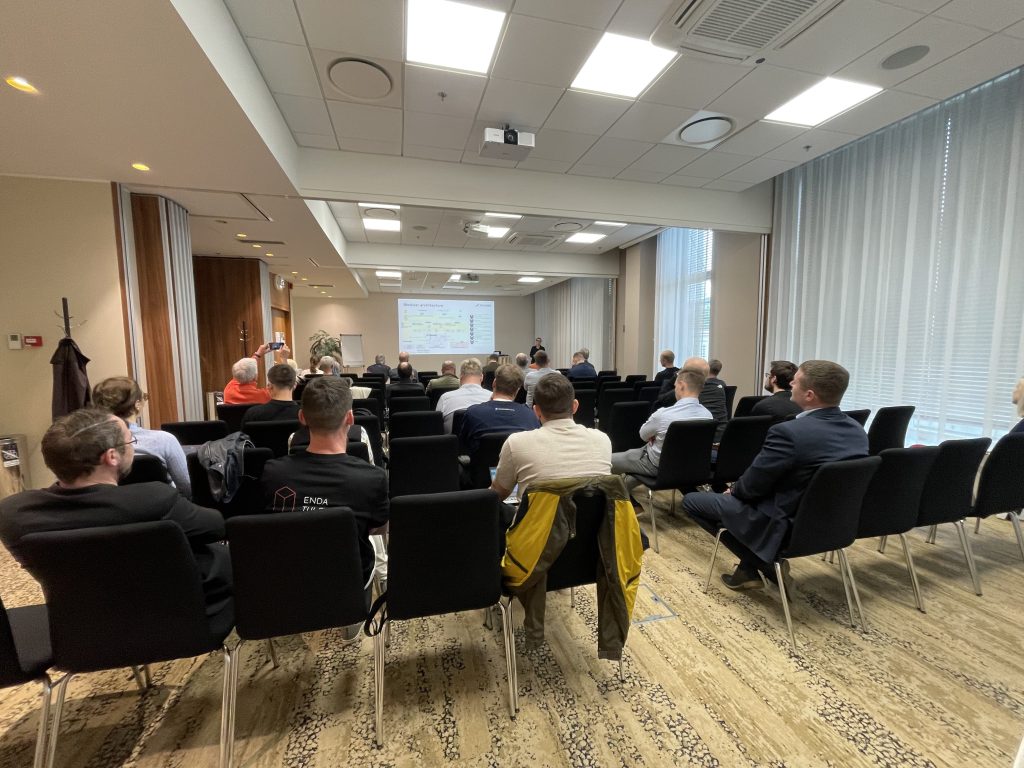
On June 5, the third “Smart Skies” project partner seminar took place in Tartu, focusing on the potential of unmanned aerial vehicles in urban environments, their role in supporting emergency services, and the challenges of implementing drone technologies in line with existing regulations. The event gathered around 40 participants, and the program highlighted Estonia’s experience through practical case studies.
Regulations – do they support or hinder innovation?
The seminar opened with a presentation by Olari Püvi from Accelerate Estonia, who explained how, through cooperation with the public sector, including the Estonian government, proposals for legislative amendments are being developed to accelerate the testing and market introduction of innovative solutions.
The organization is currently working on creating “sandboxes” – closed and strictly regulated areas where drone manufacturers could test their technologies legally. However, as Olari pointed out, one of the main obstacles in developing such areas is the lack of data on the economic benefits of innovation testing. Without supporting data, achieving legislative changes is more difficult, even though such amendments would help expand testing opportunities, benefiting not only businesses but also the public sector.
The topic of regulations was also addressed by Tõnu Pärn, a representative of the Estonian Academy of Security Sciences, who mentioned GDPR and noted that data protection remains a challenge for the drone industry not only in Estonia but across Europe – how drone technologies can comply with these requirements. He compared drone use and regulations across other European countries, including GDPR, data storage and management practices, restrictions, and potential solutions. According to Tõnu Pärn, UAVs could significantly improve public safety, since they can cover wide areas, provide fast and efficient data collection, and enable real-time situational assessment. However, it is crucial to find ways to integrate these advantages with legal frameworks.
Opportunities offered by drone technologies today
The company Rae Geodeesia, represented at the seminar by its director Mart Rae, specializes in construction geodetic work and relies exclusively on drones to deliver its services. With this technology, the company produces high-quality video and photography to document processes at various construction and infrastructure sites – roads, power lines, as well as forestry, agriculture, and natural areas. According to Rae, drones have made the working environment much safer, since dangerous surveying tasks at high-risk sites are now performed by UAVs. Project design and data collection have also become significantly more time-efficient.
The potential of drones to not only improve service efficiency but also save lives in emergencies was emphasized by Maria Tamm from the Estonian Aviation Academy, who presented the European project SAFIR-Ready. Its goal is to provide emergency response and medical solutions using UAVs – for example, delivering medicines, transporting organs for transplantation, or assessing crisis situations. As the project name suggests, the core aim is to establish a “mission-ready” drone unit capable of rapid, automated approval for beyond-visual-line-of-sight (BVLOS) flights, thereby strengthening healthcare, reducing response times, cutting transport costs, and lowering carbon emissions. As Maria Tamm revealed, the first pilot trials are scheduled for this autumn.
Ensuring public safety, UAVs have also become an effective tool for the Estonian Police and Border Guard Board. Service representative Arko Gert Tuisk explained that drones are currently used for border surveillance, missing persons searches, tactical operations, evidence collection in criminal or accident investigations, public safety during large-scale events, and VIP protection. He stressed that UAVs are an invaluable resource for optimizing operations and saving time in critical situations, while also improving officer safety – drones can assess tactical scenarios without putting lives at risk. However, challenges remain, including GPS interference, widespread use of commercial drones, and a shortage of trained UAV operators. Future improvements could include increasing the number of professional pilots, expanding site mapping for investigations, and deploying drones as first responders in crisis situations.
Public acceptance of drone technologies – resident surveys
To conclude the seminar, representatives from Tartu and Helsinki city administrations, Jaanus Tamm and Zacharoula Syrivli, presented resident surveys conducted within the CityAM project on public opinion regarding drones in urban areas. The results showed that most residents in both cities support drone use in urban environments if the purpose is to improve public safety, respond to emergencies, monitor the environment and wildlife, or conduct research. However, people expressed less support for drones monitoring recreational areas or traffic, and voiced concerns about potential misuse for illegal activities, data collection and privacy violations, as well as the impact of UAVs on wildlife welfare.
Alongside the Vidzeme Planning Region team, several organizations and industry representatives invited to join the “Smart Skies” project also attended the Tartu seminar – including the Civil Aviation Agency, Riga Aeronautical Institute, and the drone technology and services company dronueksperts.lv.
The next “Smart Skies” seminar will take place this September in Vidzeme. In total, five more such events are planned, to be held quarterly until the project concludes in August 2026.
The project “Joint development of drone-based municipal services” (Smart Skies (EE-LV00141)) is implemented with the financial support of the EU Interreg Estonia-Latvia program for 2021–2027.
This message reflects the author’s opinion. The program’s managing authority is not responsible for the possible use of the information contained therein.