As Latvia moves toward the European Union’s climate-neutrality goals, it is seeking new ways to reduce the construction sector’s carbon footprint and strengthen the use of local resources. One of the most significant yet underused opportunities is agro-construction – a sustainable building approach based on agricultural materials. It not only helps mitigate climate change but also creates new economic and social development opportunities for Latvia’s regions.
This topic has been brought to the forefront by the “Agro Building Carbon (ABC)” project, implemented by the Vidzeme Planning Region in cooperation with the Vidzeme University of Applied Sciences’ New Building School (JBS). The project aims to explore and strengthen the use of agricultural-based building materials, their carbon-sequestration potential, and their role in Latvia’s construction policy.
Conversations that set the direction
On September 25 of this year, project partners and industry experts gathered in Riga, at Paraugtipogrāfija, for the first joint discussion to share experiences and build collaboration networks. The conversations highlighted that hemp, straw, and other crops can significantly contribute to both construction and agriculture, while also helping to meet carbon reduction targets. It was emphasized that Latvia has a long history of cultivating these crops, yet the sector lacks sufficient processing capacity and clear regulations.
On October 28, the project’s second meeting took place in Valmiera, at the Rietumvidzeme Regional Customer Centre of Latvijas Valsts Meži (Latvian State Forests). Experts, entrepreneurs, and researchers discussed the practical and political prerequisites for the development of agro-construction. It was noted that the European Union’s new Energy Performance of Buildings Directive outlines significant emission reduction steps by 2026, and bio-based materials could play a key role in achieving these goals. However, participants also recognized that a clear national policy and support mechanisms are still missing, which would allow for broader use of these materials, for example, in improving building energy efficiency.
The participants agreed that such meetings will continue at least twice a year to ensure regular exchange of information and to foster a shared ecosystem where researchers, entrepreneurs, policymakers, and farmers collaborate.
What is agro-construction?
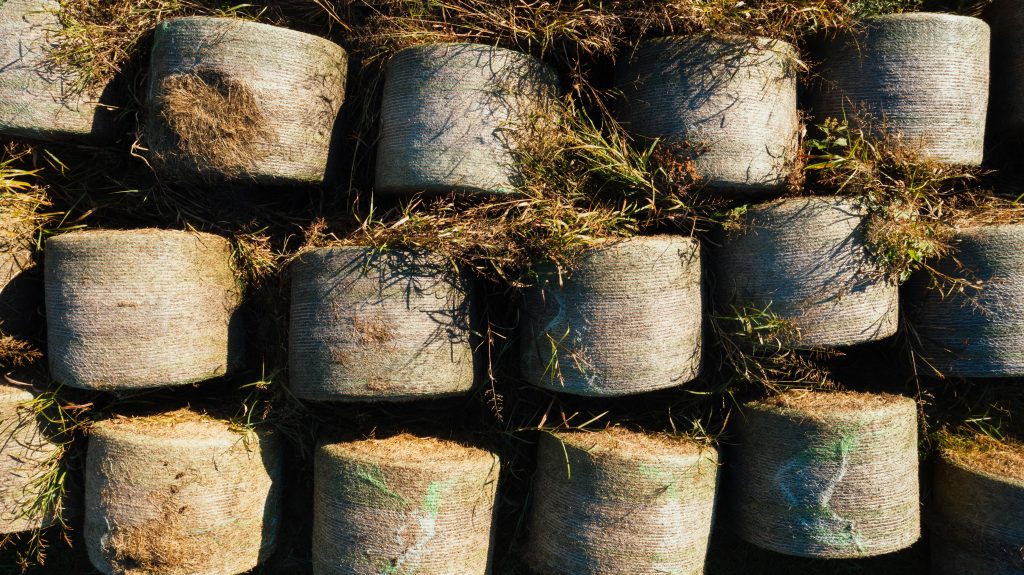
Agro-construction is a building method that uses agricultural-based materials—such as straw, hemp fibers, flax, miscanthus, or reed canary grass—to create new construction materials. This approach challenges traditional ideas about the origins of building materials by transforming agricultural by-products into high-value materials. Unlike concrete or steel, whose production generates significant CO₂ emissions, plant-based materials absorb and store carbon while growing. When these materials are incorporated into building structures, the carbon remains locked in for decades or even centuries. By building this way, it becomes possible to create carbon-sequestering buildings that not only reduce emissions but also provide a healthy and natural living environment.
In Latvia’s policy landscape – the focus is on wood
In Latvia’s policy documents, sustainable construction is being mentioned more frequently, yet the emphasis has so far been placed mainly on the use of wood as the primary natural material.
-
The National Energy and Climate Plan 2021–2030 promotes the use of local wood products;
-
The Construction Sector Development Strategy 2025–2030 foresees that public buildings should be built from wood or other solid biomass;
-
Only the Bioeconomy Strategy 2030 recognizes a broader potential, encouraging the development of new CO₂-storing materials also from agricultural residues.
However, these intentions have not yet been translated into concrete actions or financial support mechanisms. This means that Latvia currently lacks a unified policy and regulatory framework for the development of agro-construction.
From words to action – what is needed?
During the ABC project discussions, several priorities emerged that should be implemented in the coming years:
-
Identify the barriers and develop proposals for support instruments to enable wider use of natural-origin materials in construction;
-
Assess the possibilities for expanding the use of natural-origin materials in public-sector construction procurement;
-
Develop pilot projects and demonstration buildings that showcase the practical advantages of agro-construction;
-
Educate the public, the public sector, and industry professionals about the possibilities of using natural-origin materials in construction.
Latvia’s opportunity to lead
Latvia has everything needed for agro-construction to become a new direction within the bioeconomy — fertile land, agricultural resources, research capacity, and growing public interest in sustainable solutions.
The key question now is not “if”, but “how quickly” we can act — how to adapt policy, regulations, and the education system to open the door for this sector. Across Europe, interest in carbon-storing materials is rapidly increasing, and those who move first will gain significant advantages.
For Latvia, this is an opportunity to combine climate goals with regional economic growth, creating a new market, new skills, and a sustainable future for the construction sector.
About the project
An essential part of climate solutions lies at the intersection of the agriculture and construction sectors.
The “Agro Building Carbon” (ABC) initiative aims to strengthen regional policy support for enhancing CO₂ capture (sequestration) through the use of agricultural crops suitable for construction, such as straw and bamboo. These crops are processed and used in bio-based building materials, forming the basis for sustainable, carbon-sequestering construction.
The project focuses on adapting and improving policies, instruments, and financing programs that support more effective carbon storage in the construction sector. These policy instruments include regional climate visions and strategies, as well as frameworks for rural development and the circular economy.