On April 9, 2026, an international seminar titled “Waste Less, Create More: Circular Solutions for Restaurants” took place in Tallinn, bringing together industry professionals, chefs, entrepreneurs, and policymakers from the Baltic and Nordic countries. The event focused on practical solutions for reducing food waste and implementing circular economy principles in the food service sector.
The seminar was organized with the aim of directly engaging the Estonian restaurant industry, offering local businesses the opportunity to learn about tested solutions already implemented in other countries. At the same time, it served as a platform for the international dissemination of the Ce4Re project results, extending their impact beyond partner countries and promoting the practical adoption of these tools in Estonia.
The event was organized by the Vidzeme Planning Region in cooperation with the Estonian Hotel and Restaurant Association and was moderated by the association’s representative, Külli Kraner, who emphasized that the industry needs concrete, easy-to-implement solutions rather than purely theoretical recommendations.
From Policy Framework to Everyday Business Practice
Kristel Kibin from the Estonian Ministry of Climate highlighted that reducing food waste is becoming an increasingly important priority at the national level. This means that businesses will not only have the opportunity but also the necessity to adapt to more sustainable operations in the future.
“We are currently shifting from waste management to waste prevention. By 2030, EU Member States must achieve a reduction of food waste by 10% in the manufacturing and processing sectors, and by 30% per capita in retail, restaurants, the food service sector, and households,” said Kibin.
The Importance of Data – How Measurement Changes Results
Liene Klišāne, an expert from the Vidzeme Planning Region, presented a digital tool developed within the project that allows restaurants to systematically record waste at different stages – from preparation to customers’ plates.
Pilot project results showed that significant reductions can be achieved within the first months – food waste in restaurants decreased by up to 28% on average. However, the most important benefit is a shift in mindset: employees begin to see food as a resource, and its waste as both an environmental and financial issue. Restaurants not only started analysing where waste occurs (during preparation, storage, serving, or on customers’ plates) but also began tracking its value in monetary terms, recognizing the extent of “money thrown away.” This enabled them to identify specific problem areas and make targeted decisions, while also implementing new solutions and strengthening employees’ sense of responsibility for food use.
“Restaurants are already implementing simple yet effective solutions in practice – adjusting menus by removing less popular dishes, reusing food leftovers in new meals, cooking in smaller batches and replenishing buffets more frequently, using smaller serving dishes, utilising vegetable trimmings and peels for broths, and offering customers the option to take food away,” emphasized Klišāne.
Sustainability as a Strategy, Not a Compromise
Particular interest was generated by the experience of the “Re:Maize” bakery, presented by Svetlana Riškova, President of the Latvian Chefs’ Club and President of the Bocuse d’Or Latvia Academy. This example demonstrated how circular economy principles can form the foundation of a business rather than just an additional initiative.
The company is based on a sustainable and seasonal production approach, inspired by Latvian and Scandinavian culinary traditions. It follows a zero-waste principle, efficiently using raw materials and reducing food waste, while offering environmentally friendly packaging solutions and encouraging customers to use reusable containers.
“It all started with a conscious desire to be responsible and transparent with customers – and over time, it became clear that this is not only a value but also a practical way to reduce costs and operate more efficiently,” said Riškova.
The company collaborates with partners for recycling, implements full waste sorting and composting, and educates the public on sustainable consumption. Energy-efficient technologies are used in production, and the product range includes vegan, vegetarian, and gluten-free options – combining quality, innovation, and environmental responsibility.
A New Approach to Menu Planning – From Waste to Value
Project partners from Pyhäjärvi Institute Finland Pekka Maijala and Ellinoora Havaste, demonstrated how a menu planning tool helps chefs view ingredients from a different perspective.
The presentation emphasized that many components traditionally considered waste can become the basis for new dishes. For example, vegetable peels can be used in snacks, coffee grounds in desserts, and less commonly used fish parts in new recipes. This approach not only reduces waste but also expands gastronomic possibilities.
Making the Invisible Work Visible
Meanwhile, Ce4Re project partner from Sweden, Ted Wendt, presented the EkoGo application, which covers 536 restaurants, highlighting a key issue – many sustainability initiatives in restaurants remain invisible to customers. As a result, businesses often do not receive proper recognition for their efforts.
The application is available here.
“In Google environments, restaurants can add various attributes, but this does not create a structured and accurate picture of how a chef actually works and what values are practiced daily – that is the main difference compared to the EkoGo application,” emphasized Wendt.
Digital solutions help make this information accessible and understandable, enabling customers to make more informed decisions. At the same time, they provide businesses with insights into customer behaviour and help them adapt their offerings.
International Cooperation as a Foundation for Growth
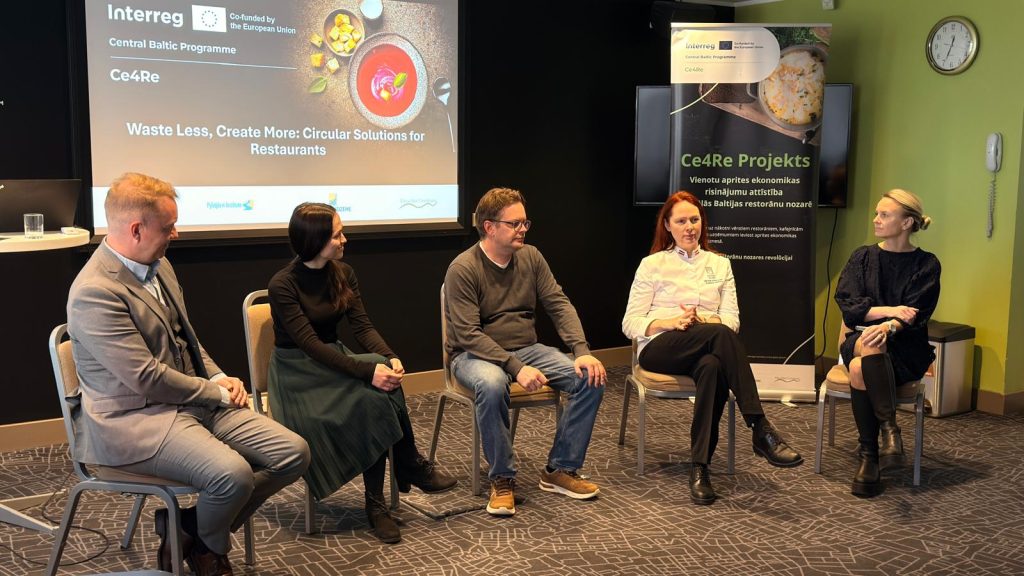
The seminar concluded with a panel discussion titled “How Estonian restaurants can benefit from circular economy solutions?”, where experts and industry representatives discussed practical ways to implement sustainable solutions in restaurant operations. The discussion was moderated by Külli Kraner and featured Dr. Altti Näsi (Satakunta University of Applied Sciences), Ted Wendt (Ekomarcentrum), Kristel Kibin, and Svetlana Riškova.
The discussion highlighted that the development of the circular economy can significantly foster international cooperation and knowledge transfer, enabling proven solutions to be successfully implemented in new markets, including Estonia. Experts also noted that sustainability involves not only reducing food waste but also having a broader societal impact, and that each business must find the most suitable solution for itself. A key prerequisite was also emphasized – sustainable business is not possible without financial viability.
About the Project
The project “Ce4Re” (Development of joint circular solutions in the CB restaurant sector) is implemented within the Interreg Central Baltic Programme 2021–2027. Its goal is to promote sustainable resource use in the food service sector by helping restaurants optimize resource planning and reduce environmental impact. The project involves partners from Latvia, Finland, and Sweden.
Co-funded by the European Union (EU). The views and opinions expressed are those of the author and do not necessarily reflect those of the EU. Neither the EU nor the granting authority can be held responsible for them.