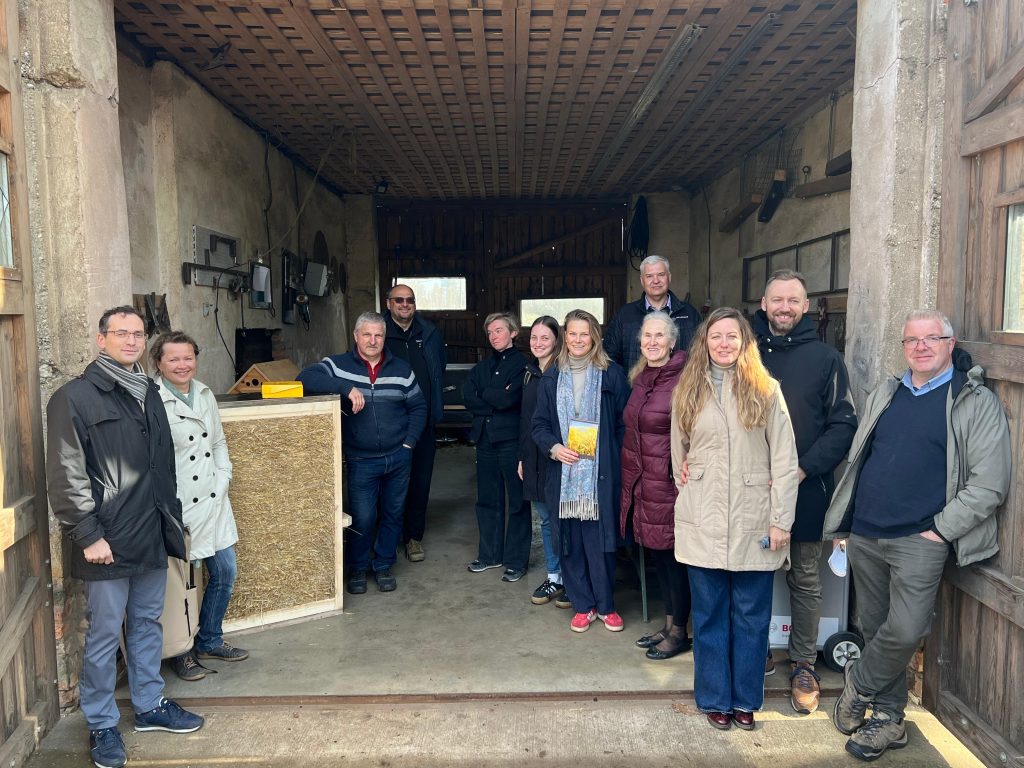
On 17 April, an experience exchange visit was held in the Valmiera region as part of the project “Agro Building Carbon/ABC”, focusing on practical examples for the development of agro-based construction in Latvia. The aim of the visit was to discuss the use of local bioresources in construction, the availability of raw materials, and circular cooperation models between the agricultural and construction sectors, as well as to explore practical solutions in which agricultural materials can become higher value-added construction products.
One of the most significant insights gained during the visit was the opportunity to see straw panel production not as a niche experiment, but as a real technology with clear advantages and, at the same time, very specific limitations. The thickness of straw panels reaches up to 40 centimetres, and rye and winter wheat straw are used in their production. This choice is determined by the material properties — due to their one-year growth cycle, these types of straw contain a higher level of cellulose, which is important for producing high-quality panels. Together with wood and clay, they form a material system based on the use of local resources.
During the visit, it became clear that the main challenge for the development of straw panels at the moment is not only interest in the material itself, but also production capacity. One day is needed for timber preparation, while two people can prepare a large panel in approximately one and a half to two hours. A panel weighs around 200 kilograms, demonstrating that production is a physically intensive and carefully organised process. With the current resources, two people can produce enough panels for a house of approximately 100 m² within a month. This is a good indicator for small-scale production, but at the same time a reminder that the further development of the technology is closely linked to increasing production capacity.
The availability of raw materials is equally important. This is where the topic of agro-based construction becomes particularly interesting, because the discussion is not only about straw as a construction resource, but also about a much broader circular economy model. Farmers often have bioresources or residual materials that are not fully utilised in everyday farming practices, yet they can become valuable raw materials for new products. This perspective was further illustrated by the experience of the farm “Gaiķēni”, where all approximately 300 hectares are dedicated to seed production, cultivating crops such as peas and buckwheat. This example demonstrated how organic farming methods help reduce dependence on external resources, as there is no need to purchase pesticides or chemical mineral fertilisers. Instead, greater focus can be placed on internal cycles and resource circulation within the farm. This is where the connection with agro-based construction becomes especially clear — agricultural by-products and bioresources can become part of a broader value chain in which the residual output of one sector becomes the raw material for a new product in another sector.
The visit also provided an opportunity to highlight the technical properties of straw panels, which are still sometimes viewed with scepticism by the public. It was emphasised that straw panels demonstrate a high level of fire safety, as confirmed by empirical experiments. A key factor is the high density of the panels, approximately 120–130 kg/m³. This dense structure reduces the amount of air within the material and therefore significantly influences its behaviour when exposed to fire.
At the same time, the fibrous and dense structure of straw also provides protection against rodents. This is an important aspect, as one of the most common misconceptions regarding natural materials is the assumption that they necessarily require additional chemical treatment. During the visit, it was explained that the straw panel production technology and the specific properties of the material itself make it possible to avoid the use of fungicides, repellents, and flame retardants, while still meeting the quality requirements expected from modern building materials. This is a strong argument in favour of the wider use of natural materials, as it demonstrates that high quality does not always require more complex or chemically intensive solutions.