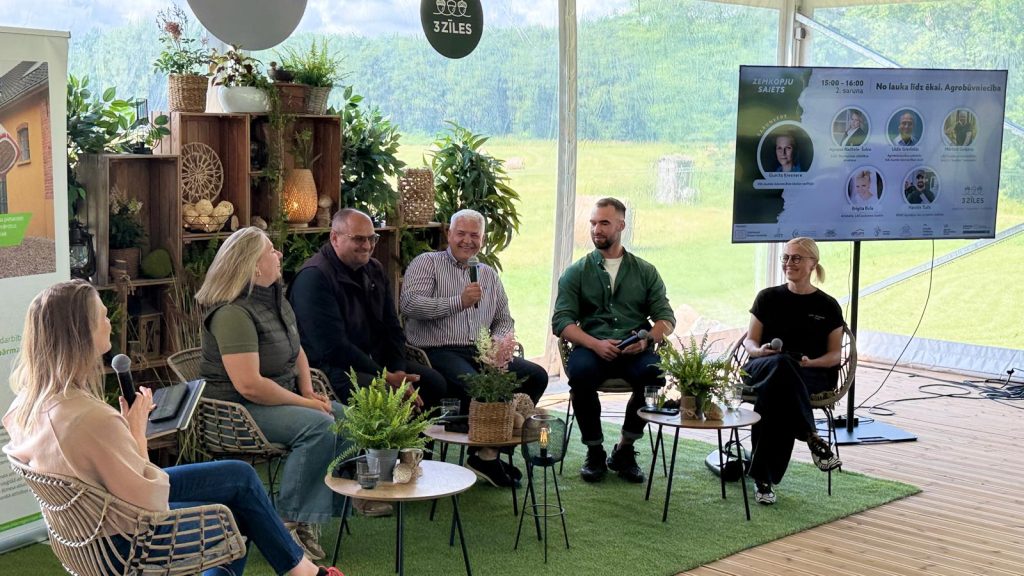
On 8 July, one of the central discussions at the “3 ZĪLES” farmers’ gathering, held at the Latvian Rural Advisory and Training Centre (LLKC) training and demonstration centre Lielozoli, focused on “From Field to Building: Agro-Building.” Experts, researchers and practitioners explored the opportunities of the bioeconomy, cooperation between the agriculture and construction sectors, and sustainable solutions for rural development.
This year’s theme of the 3 ZĪLES gathering was “Heritage: Farmstead. Buildings. Landscape. Soil. Community.” The event encouraged participants to view the traditional farmstead not merely as a collection of buildings, but as a living system where people, nature, landscape and soil are closely interconnected. Alongside discussions on architecture, landscape and community, particular attention was given to how agricultural resources can become the foundation for sustainable construction while creating new added value in rural areas.
The discussion “From Field to Building: Agro-Building” was moderated by Gunita Ķiesnere, Head of the New Construction School at Vidzeme University of Applied Sciences. The panel featured Agnese Radzēle-Šulce, Strategic Development Director at the Latvian Rural Advisory and Training Centre (LLKC); Uldis Grīnfelds, Agro-Building Researcher at the New Construction School of Vidzeme University of Applied Sciences; Mārtiņš Gaiķēns, Chairman of the Latvian Organic Farming Association and owner of the organic farm Gaiķēni; Hardijs Tučs, Sustainable Building Project Manager at RB&B; and Brigita Bula, architect and Board Member of the Latvian Association of Architects.
Opening the discussion, Gunita Ķiesnere stressed that the aim was not simply to discuss agriculture and construction as separate sectors, but to explore the possibility of creating an entirely new branch of the bioeconomy in which agriculture becomes a full partner of the construction industry. She encouraged participants to see farmers not only as producers of food and energy resources, but also as suppliers of construction materials, with crops capable of storing carbon and contributing to sustainable buildings. At the same time, she noted that the journey “from field to building” is far from straightforward—it includes cultivation, processing, logistics, certification, design, financing and market demand. Connecting all these stages remains one of the sector’s greatest challenges.
Discussing Latvia’s opportunities, the panel repeatedly emphasised that the country should move beyond exporting raw materials. Mārtiņš Gaiķēns pointed out that the future lies in creating products with higher added value. Rather than exporting grain or other agricultural commodities, Latvia should use them to manufacture construction products—or even complete buildings. Such an approach would significantly increase the value generated per hectare while strengthening the national economy. He also acknowledged that many farmers are seeking new directions, as traditional crop production and the export of unprocessed raw materials are becoming increasingly less competitive.
“The first step is always research. We must first understand the properties of a material, verify whether it performs as expected, and only then proceed with testing, certification and market deployment. If we want agro-building to become a recognised industry, we need not only materials, but also proof that they work,” emphasised researcher Uldis Grīnfelds.
A significant part of the discussion focused on the need to change the way we think about construction. Participants agreed that sustainable solutions cannot be assessed solely by their initial construction costs.
“The traditional farmstead teaches us not only to use local materials, but also to think like good stewards—to use available resources wisely and plan for the long term,” said Hardijs Tučs.
Architect Brigita Bula explained that the architect’s role is to act as a translator between the client’s needs, locally available resources, cultural heritage, building materials and long-term development goals. Meanwhile, Agnese Radzēle-Šulce highlighted that every decision—whether related to food or construction—has long-term consequences. Choosing the cheapest option often overlooks operating costs, impacts on health, the environment and the local economy. Buildings should therefore be evaluated over their entire life cycle rather than only at the moment of construction.
The discussion also examined the barriers preventing wider use of bio-based construction materials. Participants agreed that Latvia has both the knowledge and the raw materials, yet practical examples, the courage to test innovative solutions and convincing evidence of their effectiveness are often lacking.
The panel stressed that research, material testing and certification are essential, but so are pilot projects and demonstration buildings that allow professionals and clients alike to experience the performance of bio-based materials in practice.
“Legislative changes alone will not be enough. We first need good examples. Once we can demonstrate in practice that bio-based materials work, the next steps will become much easier for both designers and clients,” noted Uldis Grīnfelds.
Several speakers agreed that real-life examples are far more convincing than theoretical presentations or regulatory documents.
In the closing part of the discussion, the experts were invited to consider where they would invest resources to accelerate the development of agro-building in Latvia. Although various proposals were put forward—from improving infrastructure to strengthening knowledge transfer—there was broad consensus that the greatest impact would come from practical demonstration projects. Participants suggested developing pilot buildings, demonstration farms and even small villages where people could not only observe but also experience the benefits of bio-based building materials in everyday life. They agreed that practical examples based on Latvian experience are the best way to build confidence in innovative solutions and encourage their wider adoption across the construction sector.
The discussion attracted a wide audience, including farmers, architects, professionals from the construction and timber industries, researchers and other participants of the 3 ZĪLES gathering. The lively exchange of ideas demonstrated the growing interest in agro-building and bio-based construction materials in Latvia, as well as a shared willingness among different sectors to work together towards common solutions.
About the project
The discussion was organised within the framework of the Interreg Europe 2021–2027 project “Agro Building Carbon (ABC)” In Latvia, the project is implemented by the Vidzeme Planning Region in cooperation with the Vidzeme University of Applied Sciences.
The project’s objective is to improve regional policy instruments that create economic opportunities for the production of bio-based construction materials and the development of their associated value chains. This will be achieved by identifying and exchanging good practices related to these materials and the supporting policy instruments, with particular attention to carbon storage certification.